
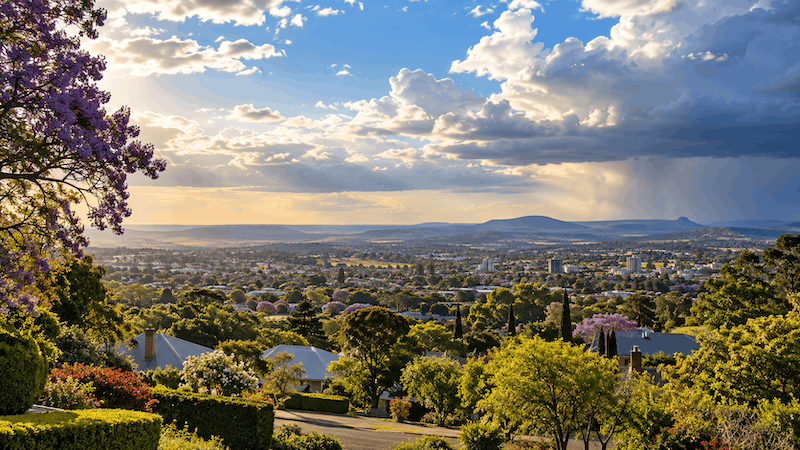
Summers are warm and can bring thunderstorms, winters can be genuinely cold, spring is famous for gardens and flowers, and autumn often delivers some of the most comfortable weather of the year.
Whether you are checking the Toowoomba weather before heading out, planning a visit, moving to the region or simply wondering what conditions are normally like throughout the year, this guide explains what to expect.
For today’s conditions, rain radar and weather warnings, check the latest Toowoomba forecast from the Bureau of Meteorology before making weather-sensitive plans.
In this guide
Toowoomba climate at a glance
Toowoomba weather by month
Summer weather in Toowoomba
Autumn weather in Toowoomba
Winter weather in Toowoomba
Spring weather in Toowoomba
How much rain Toowoomba gets
When storms are most common
Whether Toowoomba is colder than Brisbane
Snow and frost in Toowoomba
The best time of year to visit
Planning outdoor activities
Toowoomba weather and your home
Wet-weather activities
Frequently asked questions
Toowoomba climate at a glance
Toowoomba sits roughly 700 metres above sea level on the Great Dividing Range. That elevation is one of the main reasons the city experiences cooler nights and colder winters than many people expect from Queensland.
At the current Bureau of Meteorology Toowoomba Airport weather station:
The average annual maximum temperature is about 23.3°C
The average annual minimum temperature is about 12.7°C
January has the highest average daytime maximum at 28.4°C
July has the lowest average daytime maximum at 16.7°C
July’s average overnight minimum is 6.7°C
Average annual rainfall at the current station is about 740 mm
Rainfall is generally higher during the warmer months than through the middle of winter
These are long-term averages rather than limits. Toowoomba can experience considerably hotter summer days, freezing or near-freezing winter mornings, severe thunderstorms and large differences in rainfall from one year to another.
You can also view the Bureau of Meteorology climate averages for Toowoomba Airport.
Toowoomba weather by month
Here is a useful month-by-month guide based on long-term averages from the current Toowoomba Airport weather station.
MonthAverage maximumAverage minimumAverage rainfallJanuary28.4°C17.7°C89.7 mmFebruary27.7°C17.6°C103.2 mmMarch26.1°C16.5°C90.7 mmApril23.2°C13.5°C29.8 mmMay19.8°C10.0°C48.5 mmJune17.0°C7.5°C33.5 mmJuly16.7°C6.7°C30.3 mmAugust18.9°C7.7°C29.6 mmSeptember22.4°C10.6°C31.8 mmOctober24.8°C13.0°C65.8 mmNovember26.4°C14.9°C79.8 mmDecember27.7°C16.7°C103.5 mmSource: Bureau of Meteorology, Toowoomba Airport station 041529. Climate averages describe long-term conditions and should not be used as a substitute for the current forecast.
The averages are useful for planning ahead, but Toowoomba weather can change quickly. A mild morning can turn into a hot afternoon, and warm-season thunderstorms can develop rapidly.
Summer weather in Toowoomba
December to February
Summer in Toowoomba is warm without the consistently tropical feel experienced further north in Queensland.
Average daytime maximums sit at around 28°C, while overnight temperatures generally average between 17°C and 18°C.
That does not mean Toowoomba avoids serious heat. Temperatures above 30°C are common during hotter spells, and heatwaves can push daytime temperatures well beyond the monthly average.
Summer is also one of Toowoomba’s wetter periods. December and February each average more than 100 mm of rainfall at the current airport weather station, although rainfall varies considerably from year to year.
Summer storms in Toowoomba
Thunderstorms are an important feature of the warmer months across Toowoomba and the Darling Downs.
Storms can bring:
heavy rainfall
frequent lightning
strong or damaging winds
large hail
localised flash flooding
Storm activity can also be very localised. One suburb may receive heavy rain or hail while another part of Toowoomba experiences relatively little.
The Bureau advises that thunderstorms in Australia are most common from September through to March. You can read more about thunderstorms and severe weather on the Bureau of Meteorology website.
If thunderstorms are forecast, check the current radar and weather warnings rather than relying only on a forecast you looked at earlier in the day.
What to wear in Toowoomba during summer
Light, comfortable clothing is generally suitable during the day.
It is also sensible to have:
a hat and sunscreen
drinking water
an umbrella or rain jacket
a light extra layer for cooler evenings
If you are planning outdoor activities, check the UV forecast as well as the temperature.
Autumn weather in Toowoomba
March to May
Autumn can be one of the most pleasant times of year in Toowoomba.
March is still quite warm, with an average daytime maximum of about 26°C. By April, the average maximum has fallen to around 23°C, while May averages just under 20°C.
Night-time temperatures also begin falling noticeably. May has an average minimum of around 10°C.
For locals and visitors, this often means comfortable conditions for walking, visiting parks and gardens, outdoor dining, markets, community events and day trips around the region.
March can still bring humid days and thunderstorms, while April and May increasingly take on the cooler, drier feel associated with Toowoomba autumns.
If you are looking for ideas for a day out, see our family-friendly things to do in Toowoomba guide.
Winter weather in Toowoomba
June to August
Yes — Toowoomba really does get cold.
By Queensland standards, winter conditions can be surprisingly chilly.
Average daytime maximums are around 17°C in June and July, while July has an average overnight minimum of just 6.7°C.
These are averages, so colder mornings certainly occur. Temperatures can fall close to freezing and occasionally below zero in colder parts of the region.
Does Toowoomba get frost?
Yes.
Frost can occur in Toowoomba during the colder months, particularly on clear and calm winter nights.
Local conditions matter. Lower-lying, sheltered and rural areas around the city may experience heavier frost than locations higher up or closer to built-up areas.
This is particularly important for gardeners, nurseries, farmers, people growing frost-sensitive plants and motorists leaving vehicles outdoors overnight.
What does a Toowoomba winter feel like?
Winter days can be beautifully clear and sunny.
The surprise often comes early in the morning and after sunset.
Once the sun disappears, temperatures can fall quickly, and a proper jacket becomes useful.
Visitors should not assume that because Toowoomba is in Queensland they can pack as if they were heading to the coast or tropical north. Layers are your friend.
Spring weather in Toowoomba
September to November
Spring is the season most closely associated with Toowoomba.
September’s average daytime maximum is around 22°C, increasing to approximately 25°C in October and 26°C in November.
Early spring mornings can still be cool, but daytime conditions become increasingly warm as the season progresses.
Spring is particularly significant because of Toowoomba’s parks, gardens and the annual Carnival of Flowers. September brings visitors from across Queensland and interstate to enjoy the gardens, floral displays and spring events.
As the weather warms through October and November, thunderstorm activity also becomes more likely.
For garden visits, picnics, outdoor dining, markets and exploring the city, spring can provide an excellent balance between comfortable daytime temperatures and cooler evenings.
Check the Buy Local Toowoomba Events calendar to see what is happening across Toowoomba and surrounding communities during your visit.
How much rain does Toowoomba get?
You may see very different annual rainfall figures quoted for Toowoomba.
There is a good reason for that.
The current Bureau of Meteorology weather station at Toowoomba Airport records average annual rainfall of about 740 mm.
However, the older Toowoomba city weather station, which operated from 1869 until 2007, recorded average annual rainfall of about 952 mm.
That does not mean one figure is right and the other is wrong.
They come from different weather stations, different elevations and positions, and different periods of observation.
Rainfall can vary significantly across a city positioned along the Great Dividing Range.
For current climate comparisons, the operational Toowoomba Airport weather station is the most useful reference.
For understanding Toowoomba’s longer historical climate, the older Toowoomba city weather station remains valuable.
The practical takeaway is that Toowoomba generally receives more rain during the warmer months, while the middle of winter tends to be considerably drier.
When is storm season in Toowoomba?
There is no official Toowoomba storm season with an exact start and finish date.
The Bureau says thunderstorms across Australia are most common during the warmer months from September through to March. For Toowoomba, spring and summer are therefore particularly important periods for storm awareness.
Severe thunderstorms can produce:
damaging winds
large hail
intense rainfall
flash flooding
frequent lightning
Toowoomba’s elevation and position near the Great Dividing Range can also contribute to rapidly changing local conditions.
If severe weather is forecast, use current Bureau of Meteorology forecasts and warnings rather than relying on general climate information.
Is Toowoomba colder than Brisbane?
Generally, yes — particularly overnight and during winter.
Brisbane sits close to sea level, while Toowoomba is approximately 700 metres above sea level. That elevation contributes to cooler conditions.
However, there is no reliable rule saying Toowoomba will always be a particular number of degrees colder than Brisbane.
The difference varies according to cloud cover, wind direction, humidity, weather systems, season and time of day.
If you are travelling from Brisbane to Toowoomba during winter, taking an extra layer is usually a good decision.
Does it snow in Toowoomba?
Snow in Toowoomba is exceptionally rare.
It is not something residents or visitors should normally expect during winter.
Frost, cold winds and near-freezing mornings are far more relevant to normal Toowoomba winter weather.
Occasionally, unusual weather events create excitement about sleet or possible snow in elevated parts of the Darling Downs, but these events are uncommon.
If unusual winter weather is forecast, check current Bureau information rather than relying on old photographs or social media posts.
What is the best time of year to visit Toowoomba?
That depends on what you want to experience.
Spring
Spring is the obvious choice for gardens, flowers and major events.
September is especially popular because of the Toowoomba Carnival of Flowers.
Autumn
Autumn is excellent for visitors who prefer comfortable daytime temperatures and cooler evenings.
It is a particularly good time for exploring the city, dining out, walking and taking day trips around the region.
Winter
Winter suits visitors who enjoy crisp mornings, cafés, clear days and cooler walking weather.
Just remember to bring warm clothing.
Summer
Summer brings longer days, warmer weather and greener landscapes.
It can be an enjoyable time to visit, but you should be prepared for hot days, thunderstorms and rapid changes in weather.
For any specific trip, the seven-day forecast is much more useful than a long-term monthly average.
Planning outdoor activities around Toowoomba weather
Toowoomba has plenty to do outdoors, but checking the weather before setting out can make a big difference.
Parks, gardens, bushwalks, markets, sporting events and community activities are all affected by heat, rain and storms.
If you are heading north of the city, our Local’s Guide to Highfields includes parks, walking trails, attractions, shopping and other ideas for exploring the area.
For more ideas around the city, browse the [Buy Local Toowoomba